

Pre-service payment policies are now standard, but performance depends on how they are operationalized.
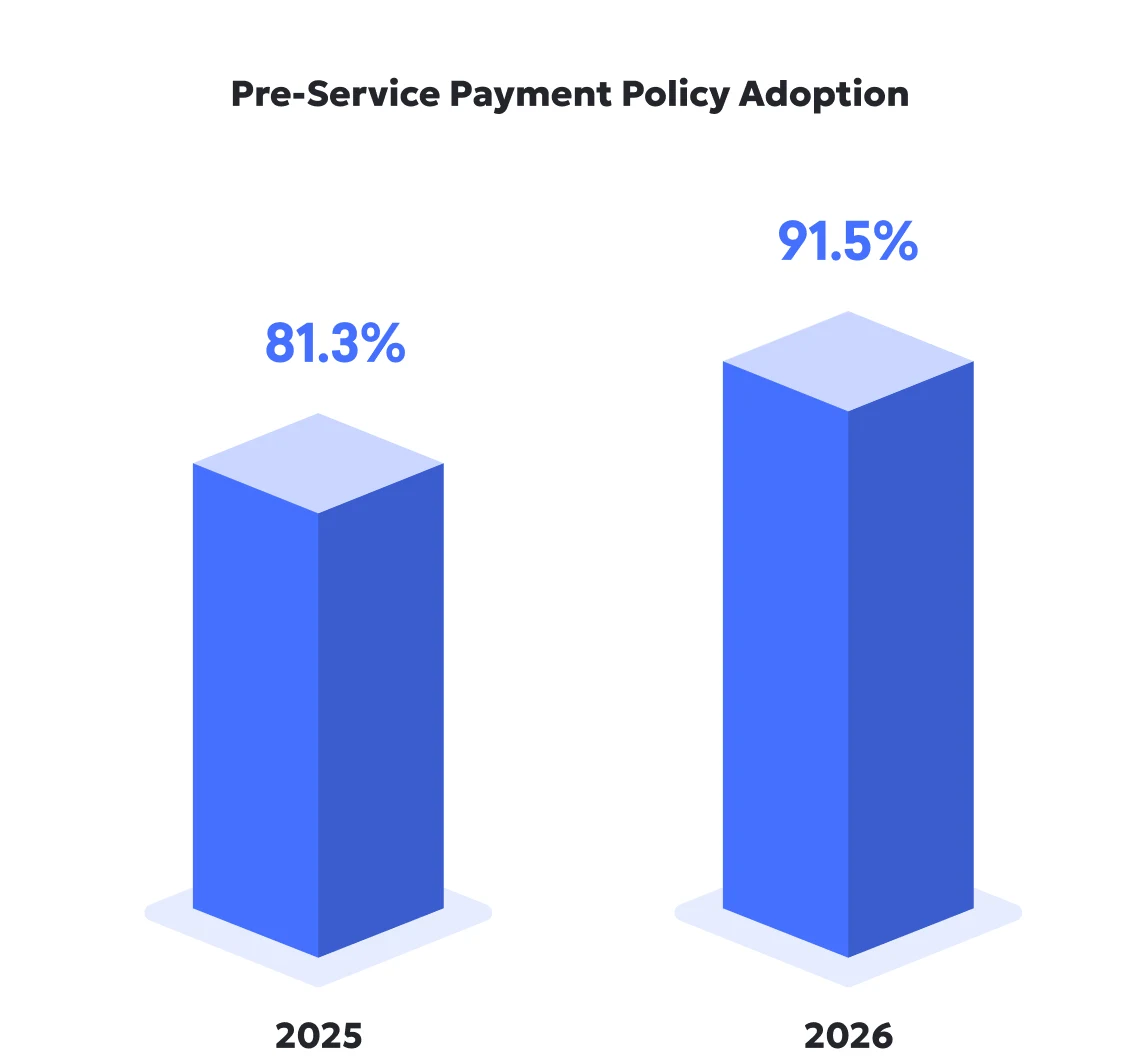
PayZen’s State of Healthcare Affordability: The Provider Perspective 2026 report found that 91.5% of surveyed health systems now have some form of pre-service payment policy, up from 81.3% the year prior. Organizations with a policy collect more than twice as much pre-service revenue as those without one.
The next opportunity is not simply asking patients to pay earlier. It is helping them understand their financial responsibility earlier and connecting them to affordable pathways forward, including patient financing options, financial assistance, Medicaid eligibility, payment plans, and compassionate escalation processes when care cannot be delayed.
Over the last several years, pre-service payment policies have moved from an emerging strategy to a standard across much of healthcare. PayZen’s State of Healthcare Affordability: The Provider Perspective 2026 report found that 91.5% of surveyed health systems now either encourage payment, require payment, or collect a payment method on file before care is delivered, up from 81.3% the year prior.
That shift is understandable. As patient financial responsibility continues to grow, many health systems are trying to move financial engagement earlier in the patient journey, before balances become harder to resolve post-service.
And the data suggests that earlier engagement matters. Organizations with a pre-service payment policy collect more than twice as much pre-service revenue as those with no policy.
But the more interesting takeaway from the data may be this: policy adoption appears to be outpacing performance gains.
Despite widespread adoption of pre-service policies, many health systems are still navigating estimate accuracy challenges, workflow complexity, staffing shortages, and affordability conversations that are increasingly difficult to operationalize at scale. The challenge is no longer whether health systems should engage patients financially before care. The challenge is how to do it in a way that is operationally sustainable and genuinely useful for patients.
That distinction is pushing many organizations to rethink pre-service not simply as a collections function, but as a broader financial navigation strategy.
The Industry Is Moving Upstream
One of the clearest themes emerging across the market is that financial clearance responsibilities are expanding well beyond traditional verification and collections workflows.
In many organizations, access teams are now being asked to support:
- Estimate communication
- Financial assistance screening
- Medicaid eligibility workflows
- Payment plan discussions
- Patient financing options
- Coverage education
- Patient outreach and follow-up
The role itself is becoming more consultative and patient-facing.
In recent PayZen discussions with Chartis healthcare consultants and revenue cycle leaders, participants repeatedly described how affordability conversations are moving closer to the point of scheduling rather than remaining downstream after care is delivered.
That trend is reflected directly in the report findings. While only 21.1% of health systems currently screen for Medicaid or financial assistance at scheduling, 61.3% believe screening should happen there in the future.
That gap says a lot about where the industry is heading. Healthcare systems increasingly recognize that once a patient arrives for the visit without understanding their financial responsibility or available support options, the opportunity to proactively influence the outcome narrows significantly.

The Operational Reality Is More Complicated
Of course, moving financial engagement earlier introduces its own operational challenges for providers.
Most health systems are already balancing staffing shortages, payer complexity, authorization requirements, and growing patient volumes. Expanding financial clearance across more service lines and patient populations is difficult to scale manually, particularly when estimate accuracy itself remains highly variable.
Denise Shue, Partner and Vice President of Product at Chartis, elaborated in a recent industry discussion:
I think that’s true for organizations that haven’t automated estimates… the biggest challenge with expanding delivery of estimates is the volume. Organizations don’t have the resources to add staff, so expanding is dependent on automation.
That operational reality helps explain why many health systems still focus estimates primarily on high-dollar elective procedures or self-pay populations. It is often less about strategy and more about capacity.
Even when organizations have access to the underlying data, transforming that information into accurate, patient-ready financial guidance remains difficult.
Mary Ann Zarkin, Partner at Chartis described the challenge this way:
How are you pinging the payer and pulling back that data? Are you able to get back good data from the payer on what that patient may owe? And are able to appropriately map it within your system? From a technology perspective, that can be a big lift.
This is part of the reason many health systems remain cautious about introducing entirely new technology ecosystems into financial clearance workflows. Most organizations have already made substantial investments in Epic infrastructure and are trying to improve workflows within existing environments before layering on additional platforms.
In practice, the challenge is often less about access to information and more about operationalizing it accurately at scale.
Compassionate Collections Can Reduce the Risk of Care Deferral
One health system demonstrating this shift from pre-service policy to financial navigation is the University of Texas Medical Branch (UTMB), an academic health system in Galveston, Texas. In a recent webinar on effective strategies for implementing pre-service payment policies, Kristi Morgan-Turner, Financial Clearance Director at UTMB, shared how the organization built a structured financial clearance program while staying grounded in its mission to care for patients regardless of their ability to pay.
UTMB’s experience is instructive because it addresses one of the central concerns revenue leaders face when strengthening pre-service policies: how to increase upfront collections without creating unnecessary care deferral or delay. The risk is real, especially when patients face high out-of-pocket costs and limited payment options. But UTMB’s approach shows that the way a policy is implemented can make the difference between creating a barrier and creating a pathway.
Rather than treating their pre-service payment policy as a hard-line payment requirement, UTMB built its approach around what Kristi Morgan-Turner described as “compassionate collections,” supported by patient financing options. That meant training staff to protect the patient’s dignity, offering real affordability options, and creating clear escalation pathways for medically necessary care. The goal was not simply to collect more upfront. It was to help patients move forward while preserving trust.
As Morgan-Turner explained:
We decided to turn collections on its ear and say we are going to advocate for the patient first. We are going to protect the patient’s dignity. We are going to take a different approach and see what happens.
That mindset shaped the operational rollout. UTMB paired its financial clearance policy with staff training, management exceptions, KPI tracking and medical necessity pathways. In practice, this allowed the organization to pursue upfront collections while still protecting patients when payment was not feasible or when care could not safely be delayed.
Morgan-Turner captured the balance clearly:
It doesn’t have to be either/or. You can be very compassionate while also having a very strict and regimented process.
For revenue leaders, the takeaway is not that every organization should copy UTMB’s model exactly. It is that pre-service performance depends on more than asking for payment earlier. Policies work best when access teams are equipped to guide patients through options, document exceptions, and escalate appropriately. When implemented this way, compassionate collections can support both financial discipline and patient access.
The Conversation Is Shifting From Payment Collection to Patient Confidence
What emerged most clearly from discussions with providers and advisors was not necessarily a debate about whether pre-service collections matter. Most organizations already agree they do.
The more nuanced conversation is around what actually enables patients to move forward.
For many systems, that means focusing less on the act of requesting payment and more on building patient confidence in the financial process itself, creating confidence in the estimate, confidence in available payment options, and confidence that the organization is prepared to work with them when affordability becomes a concern.
As Morgan-Turner shared during the discussion:
Every time we give them [the access team] a new [payment] option to offer the patient, you can just feel the energy in the teams increase, like, ‘yay, now we can tell them that we can give them an option!’ versus in the past, we didn’t always have options to give somebody who said they couldn’t pay.
Chartis also discussed how some organizations are beginning to introduce “tolerance” approaches around estimate accuracy, acknowledging that estimate variability is sometimes unavoidable.
As Derek Ottens, Partner at Chartis noted, some systems are seeing success with tolerance policies:
If you’re going to commit to your estimates, commit to a tolerance for accuracy. For example, if the estimate is off by more than X, we’re not going to hold you accountable for it.
That type of thinking reflects a broader industry shift toward reducing friction and preserving trust, particularly in situations where estimate complexity is driven by payer variability, authorization changes, or evolving treatment pathways.
A Different Model for Pre-Service Is Emerging
Technology and AI will play an important role in helping organizations scale these efforts over time, particularly as financial pressures continue. But the health systems making meaningful progress today do not appear to be relying on technology alone.
Instead, they are focusing on a more foundational question:
How do you help patients understand their financial responsibility early enough and connect them to affordable pathways, such as patient financing solutions that allow them to move forward with care?
That may ultimately become the defining question for the next era of financial clearance: not just whether patients are asked to pay earlier, but whether they are given the clarity, support, and affordable options they need to do so.